





Global health is a concept as vast as it is ambitious. Unlike local or national healthcare systems, which are bounded by geography and policy, global health spans continents, cultures, and economies. It aims not only to treat disease but to prevent it, to equalize access to care, and to anticipate the unseen crises of tomorrow. But the question remains: can the horizon of global health ever truly be reached? Or is it, by nature, a moving target—a goal that shifts further away the closer we get?
To answer this, we must navigate through history, explore modern challenges, embrace technological innovation, and confront ethical, social, and political realities. Only then can we approach an understanding of what “reaching the horizon” might even mean in the context of human health.
The Evolution of Global Health
The idea of global health is relatively modern, although its roots are ancient. Early civilizations recognized the link between sanitation, disease, and community well-being. The Romans built aqueducts and sewers; medieval cities enforced quarantine to prevent plague; indigenous populations around the world had sophisticated knowledge of medicinal plants and community health practices.
In the 19th century, with the rise of industrialization, urbanization, and global trade, diseases spread faster and farther than ever before. Cholera, smallpox, and tuberculosis became transnational threats. This era gave birth to organized public health efforts, including vaccination campaigns and the first international health regulations. The foundation of global health as a distinct field was laid during this period, recognizing that disease knows no borders.
The 20th century expanded the concept even further. The creation of the World Health Organization in 1948 formalized a global approach to health, setting international standards, coordinating disease eradication programs, and emphasizing health as a fundamental human right. The eradication of smallpox in 1980 was a historic triumph, demonstrating that coordinated global action can achieve what once seemed impossible. Yet, it also revealed the complexity of such endeavors—requiring political will, scientific innovation, funding, and cultural sensitivity.
Modern Challenges in Global Health
Despite these successes, the horizon remains distant. Modern global health faces an intricate web of challenges that are biological, social, political, and economic in nature.
Infectious Diseases
While vaccines and antibiotics have dramatically reduced mortality from many infectious diseases, new pathogens continue to emerge. The 21st century has witnessed outbreaks of SARS, H1N1, Ebola, Zika, and most recently COVID-19. Each of these crises demonstrates the fragility of global health systems and the speed at which local outbreaks can escalate into global emergencies. Pathogens evolve, travel accelerates, and climate change reshapes ecosystems—creating new opportunities for diseases to emerge.
Non-Communicable Diseases
Simultaneously, non-communicable diseases (NCDs) like diabetes, heart disease, and cancer are on the rise. Globalization, urbanization, and changes in lifestyle have turned these conditions into worldwide epidemics. Tackling NCDs requires not just medical intervention, but societal transformation—changing diets, promoting physical activity, regulating harmful industries, and addressing inequalities in access to preventive care.
Health Inequalities
Inequity is perhaps the most stubborn challenge. Even within wealthy nations, marginalized communities face poorer health outcomes, while millions in low-income countries lack basic access to clean water, vaccination, or essential medicines. The interplay of poverty, education, gender, and geography means that health improvements are rarely uniform. Global health must navigate these inequities carefully, ensuring that progress does not favor some populations while leaving others behind.
Political and Economic Barriers
Health is not immune to politics. International aid can fluctuate with changing governments and economic crises. Conflicts disrupt healthcare systems, displace millions, and foster disease outbreaks. Corruption and poor governance can hinder even well-intentioned initiatives. Funding for global health is often reactive, surging during crises and waning afterward, making long-term planning a constant challenge.
Climate Change and Environmental Health
A rising tide of evidence links environmental degradation to human health. Air pollution, deforestation, loss of biodiversity, and changing climate patterns are not just environmental issues—they are health crises. Heatwaves, floods, and droughts exacerbate malnutrition, waterborne diseases, and mental health challenges. The horizon of global health cannot be reached without addressing the health consequences of environmental change.
Technological Innovations: Tools to Reach the Horizon
Despite these challenges, technology offers hope. Medical innovation, digital health, and data analytics are reshaping the landscape of global health.
Vaccines and Genomics
Modern vaccines are faster, safer, and more targeted than ever. mRNA technology, which revolutionized COVID-19 vaccine development, could soon target malaria, HIV, and other infectious threats. Genomic sequencing allows scientists to track pathogen evolution in real-time, improving outbreak response and prevention strategies.
Telemedicine and Digital Health
Digital health platforms have the potential to bridge geographic and economic gaps. Telemedicine can provide remote consultations, AI-driven diagnostics, and personalized treatment plans to populations with limited access to healthcare infrastructure. Mobile health apps can track vaccination, monitor chronic disease, and empower patients with knowledge.
Data and Predictive Analytics
Big data is transforming epidemiology. Real-time data collection, combined with AI predictive modeling, can anticipate outbreaks before they escalate. Countries can allocate resources more efficiently, and global organizations can coordinate responses with precision.
Biotechnology and Precision Medicine
Gene editing, regenerative medicine, and targeted therapies promise a future where previously untreatable conditions can be mitigated or cured. These advances could redefine the limits of human health, making the horizon not just a distant aspiration but a tangible target—at least for those with access.
Ethical Dimensions: Equity, Rights, and Responsibility
Reaching the horizon of global health is not solely a scientific or technological endeavor—it is profoundly ethical. Global health decisions involve questions of justice, rights, and responsibility.

Who receives scarce treatments during a pandemic? How do we balance individual freedoms with public health mandates? Should wealthier nations prioritize their populations over global solidarity? How do we respect cultural differences while promoting evidence-based interventions?
Ethics reminds us that the horizon is not just a measure of technological achievement but also a reflection of our collective humanity. A world where vaccines exist but remain inaccessible to the poor is not truly healthier—it is merely inequitable.
Global Health as a Dynamic Horizon
Given these challenges and opportunities, it becomes clear that the horizon of global health is not a fixed point but a moving target. Each success raises expectations and uncovers new challenges. Eradicating smallpox opened the door to tackling polio—but new viral threats emerged. Advances in cancer treatment improved survival rates—but lifestyle-related diseases surged.
Global health is therefore dynamic, iterative, and collaborative. It is less about reaching a final endpoint and more about continuously improving human well-being while adapting to new challenges. In this sense, the horizon may never be fully reached—but it can always be approached. Every reduction in mortality, every improvement in access, every advance in prevention and treatment is a step closer.
Collaborative Approaches: The Way Forward
If the horizon is to be approached, collaboration is essential. Multilateral organizations, governments, NGOs, private sector partners, and local communities must work together. Successful initiatives often combine global expertise with local knowledge, ensuring that interventions are culturally appropriate and sustainable.
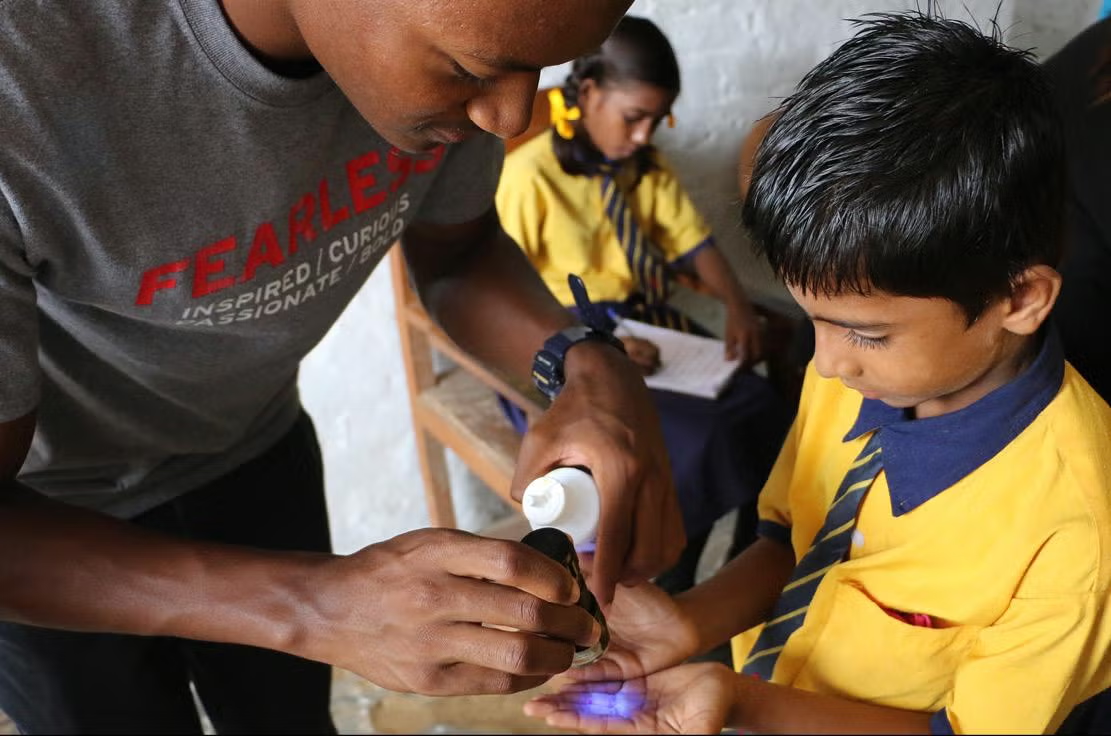
Education and empowerment are critical. Communities equipped with knowledge about hygiene, nutrition, and disease prevention are better positioned to maintain their health independently. Strengthening healthcare infrastructure, training healthcare workers, and promoting research capacity in low-resource settings are investments with far-reaching benefits.
Conclusion: An Ever-Receding Horizon?
So, can the horizon of global health ever be reached? Perhaps not in the absolute sense. Health challenges evolve, societies change, and new threats emerge. But framing it as a fixed destination may be misleading. The horizon functions better as a compass—guiding global efforts, inspiring innovation, and reminding us that progress is continuous.
The horizon represents aspiration, not finality. It is the promise of a healthier, more equitable world that motivates global cooperation and innovation. With each step forward—whether through scientific breakthroughs, policy reform, or community empowerment—we move closer. And even if the horizon always recedes, the journey itself transforms the world for the better.
Global health is, ultimately, a reflection of our collective ambition, ingenuity, and compassion. It is a horizon worth pursuing, not for the sake of reaching a perfect endpoint, but for the countless lives improved along the way.