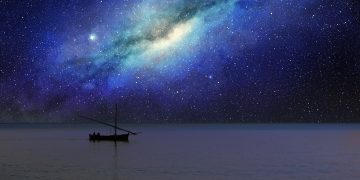








Human beings have been fascinated by the night sky for millennia. From ancient seafarers to modern-day explorers, the stars and the moon have served as reliable navigational tools. Long before GPS technology transformed how we find our way, the stars, planets, and even the phases of the moon provided invaluable guidance. But in today’s world, does celestial navigation still hold any relevance? Let’s explore the art and science of navigating by the stars and moon, and whether this ancient technique can still be useful today.
The Basics of Celestial Navigation
Celestial navigation is the practice of using visible celestial bodies—such as the Sun, Moon, stars, and planets—to determine your position on Earth. It is an ancient skill that has helped mariners, explorers, and adventurers chart courses across vast, featureless oceans or navigate across barren landscapes. At its core, celestial navigation relies on the predictable positions of celestial bodies at any given moment in time, as seen from Earth.
The two primary tools used in celestial navigation are the sextant and the chronometer. The sextant is used to measure the angle between a celestial body and the horizon. The chronometer, or an accurate clock, helps determine the precise time at which the observation is made. With these two instruments, navigators can pinpoint their location based on known celestial charts.
The Role of the Stars
Stars are the most commonly used celestial bodies for navigation. They remain fixed in the sky relative to Earth, meaning their positions don’t change much over short periods. However, stars appear to shift slightly due to the Earth’s rotation and orbit around the Sun. This predictable motion allows navigators to use specific stars, called navigational stars, as fixed reference points.
One of the most famous examples of star navigation is the North Star, or Polaris, which is located almost directly above the North Pole. Navigators in the Northern Hemisphere have used Polaris for centuries to find true north. Its position in the sky is almost stationary, making it an ideal reference for determining latitude. By measuring the angle between the horizon and Polaris, one can calculate how far north or south they are from the equator.

Using the Stars for Latitude and Longitude
To determine latitude, the key measurement is the angle between a star (or the Sun) and the horizon. This angle is known as the altitude. For example, the angle between the horizon and Polaris is equal to your latitude in the Northern Hemisphere. If you are directly under Polaris, your latitude is 90 degrees North (the North Pole). As you move southward, the angle decreases until it reaches 0 degrees at the Equator.
Determining longitude is more complex and involves measuring the time difference between a known location and the local time at your current position. By comparing the time at your position (using a chronometer) with the time at a reference location (usually Greenwich, England), you can calculate the time difference, which can then be converted into longitude.
The Moon and Its Role in Navigation
While the stars are more commonly associated with navigation, the Moon has also played a significant role in helping people find their way. The Moon’s movement is predictable, but unlike the stars, it doesn’t remain in the same position relative to the Earth. Its position changes roughly every hour, making it more challenging to use for navigation.
However, the Moon’s phases and its relationship to other celestial bodies can be leveraged for navigational purposes. By observing the Moon’s position in relation to certain fixed stars or planets, a navigator can determine both latitude and longitude. The process is more complex than using the stars, but it can be effective in the right circumstances.
The Importance of the Sun
The Sun, although a daytime object, is also an essential part of celestial navigation. The position of the Sun can be used to determine both latitude and time of day. The angle between the Sun and the horizon at noon (when the Sun is highest in the sky) gives you an indication of your latitude. The precise timing of this solar observation is also crucial for calculating longitude, as the Earth rotates 15 degrees of longitude per hour.
Using the Sun for navigation is often easier than relying on the stars or Moon because the Sun is brighter and more visible. It is especially useful for sailors, as they can track the Sun’s movement across the sky to maintain a steady course. However, solar navigation is mostly accurate at midday when the Sun is directly overhead or near the zenith. The position of the Sun at different times of day helps mariners and travelers calculate direction and distance traveled.
How Navigators in the Past Used Stars and the Moon
Before the age of GPS, the art of navigation was a skill passed down through generations. Sailors, explorers, and even desert travelers relied on the stars and the Moon to guide them through unknown terrain. Some of the most famous navigational systems used by ancient cultures include:
- Polynesian Navigation: The Polynesians were expert navigators, using the stars, the Sun, and the Moon to travel vast distances across the Pacific Ocean. They relied on a deep knowledge of the sky and a system of mental maps known as wayfinding.
- Viking Navigation: The Vikings also used the stars to navigate across the North Atlantic. They used instruments like the sunstone, a crystal that could polarize light and reveal the Sun’s position, even on cloudy days. They also had knowledge of the position of key stars, such as the North Star, to guide their long sea voyages.
- Arab Navigation: Arab sailors during the Golden Age of Islam relied on the stars for navigation, especially the use of the astrolabe—an instrument that could measure the altitude of stars to help determine time and location. They also used a system of star charts to guide them across the Arabian Sea and beyond.

These navigational techniques were not just for sailors. Nomadic desert travelers also used the stars and the Moon to cross vast, featureless landscapes. In the Sahara Desert, for example, the position of the stars and the rising and setting of the Moon were used to determine direction and distance in a landscape where landmarks were scarce.
Modern Applications of Celestial Navigation
While technology like GPS has largely replaced the need for celestial navigation, it hasn’t disappeared entirely. Some pilots, sailors, and even astronauts still practice celestial navigation as a backup method in case of GPS failure. Moreover, certain remote areas where GPS signals are weak or non-existent, such as the poles or deep in the mountains, make celestial navigation a valuable tool.
In the world of aviation, some pilots still use stars to determine their position, especially during night flights or in areas where ground-based navigation aids are unavailable. Similarly, astronauts aboard the International Space Station (ISS) use stars to orient themselves and maintain their course, as Earth-based GPS is not available in space.
Can You Still Navigate by the Stars Today?
In a world dominated by digital navigation tools, the idea of navigating by the stars might seem outdated. However, there are still instances where knowing how to read the sky can be immensely valuable. For instance, amateur astronomers, hikers, sailors, and long-distance travelers may find themselves in situations where modern technology fails them. Whether it’s a power failure, a GPS malfunction, or simply a desire to reconnect with ancient practices, the stars and the Moon offer a reliable and fascinating means of navigation.
The art of celestial navigation is not something to be learned overnight. It requires patience, practice, and a deep understanding of the sky. But for those willing to put in the time, it can be a rewarding and incredibly fulfilling skill. And in an era where we rely heavily on technology, the ancient skill of navigating by the stars can remind us of the wonders of the natural world.
Conclusion
Navigating by the stars and the Moon is more than just an ancient technique; it is a timeless skill that has guided explorers, sailors, and adventurers across the world for centuries. While modern navigation tools have made celestial navigation less essential, it remains an important part of human history and a valuable skill for those who venture off the beaten path.
The stars are still there, waiting to guide those who know how to read them. Whether you’re charting a course across the sea, trekking through remote lands, or simply gazing up at the night sky, celestial navigation offers a beautiful connection to the past, and perhaps even to the adventure that awaits.